
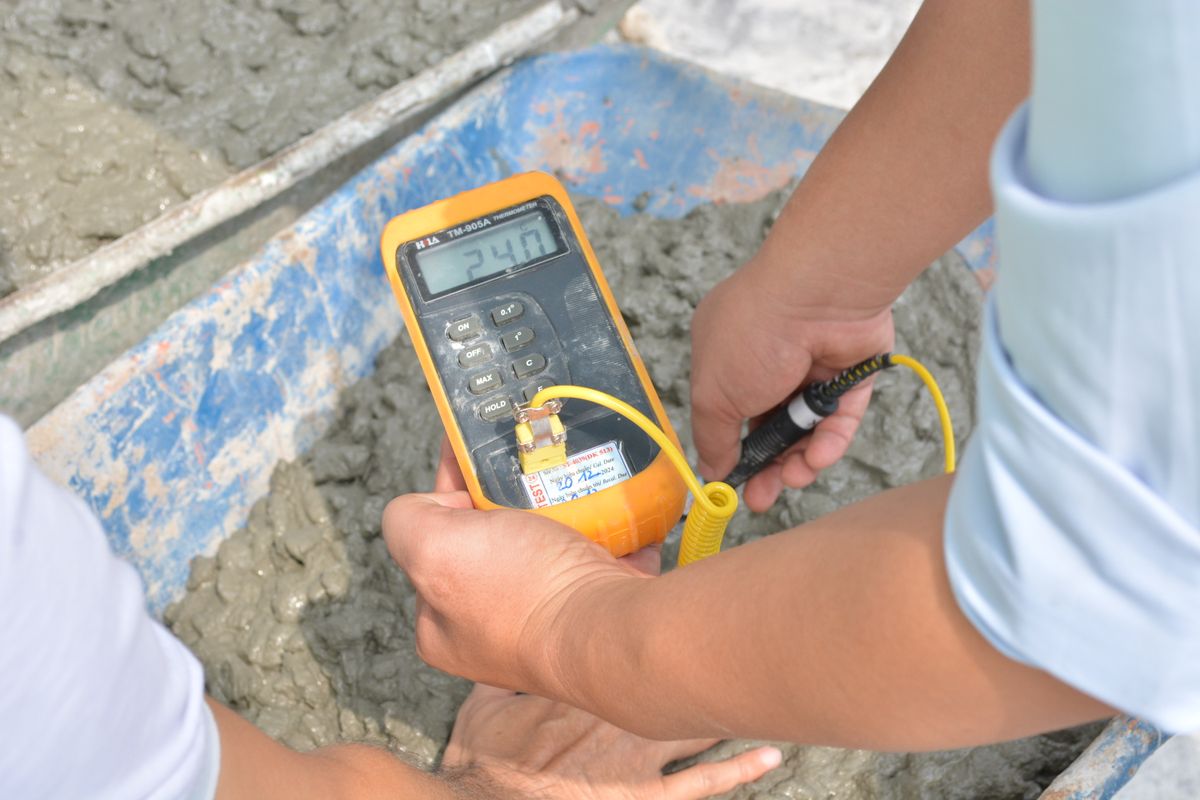
Concrete does not gain strength on a calendar. It gains strength as a function of how warm it has been and for how long. The maturity method is the engineering tool that turns that temperature history into an estimate of in-place strength — continuously, and without breaking a single cylinder.
Understanding maturity is the foundation for almost every fast, confident decision on a concrete site: when to strip formwork, when to apply post-tensioning, and when to load the next level.
The core idea: time × temperature
Cement hydration — the chemical reaction that makes concrete hard — speeds up when concrete is warm and slows down when it is cold. Two pours of the identical mix can reach very different strengths at the same age if one cured at 18 °C and the other at 40 °C.
The maturity method captures this by combining temperature and time into a single index. Measure the temperature of the concrete continuously, accumulate it over time, and you get a number that tracks strength gain far more faithfully than age alone.
Method 1 — Nurse–Saul (the temperature–time factor)
The Nurse–Saul method sums the concrete temperature above a datum (typically −10 °C) over each time interval, producing a Temperature–Time Factor in units of °C·hours.
It is simple, robust, and widely used. Its main assumption is that strength gain is linear with temperature, which holds well across the moderate-to-warm range typical of most site work.
Method 2 — Arrhenius (equivalent age)
The Arrhenius method models hydration as a chemical rate process using an activation energy, and expresses maturity as an equivalent age at a reference temperature (commonly 20 °C).
It captures the non-linear acceleration of hydration at higher temperatures more accurately — which matters in UAE summer placements — at the cost of needing an activation-energy value for the mix.
From maturity to strength
Maturity on its own is just an index. To read it as strength you need a calibrated strength–maturity relationship for your specific mix: a curve established once in the lab that maps maturity values to compressive strength.
Once that curve exists, any sensor reading from the field can be converted, in real time, into an estimated in-place strength for that exact element under its actual conditions.
Key takeaways
- Strength tracks temperature history, not age — two pours of the same mix can differ sharply at the same age.
- Nurse–Saul (°C·h) is simple and robust; Arrhenius (equivalent age) is more accurate in hot conditions.
- Maturity becomes strength only through a mix-specific calibration curve.
- Done continuously, this lets you act on verified strength instead of waiting out a conservative schedule.
See this on your own pours.
StarkCreteX puts real-time temperature, maturity, and estimated strength in your hands — from any device, anywhere in the UAE.